
PRESS RELEASE. For immediate release.
Brussels and Warsaw, 25 November 2026
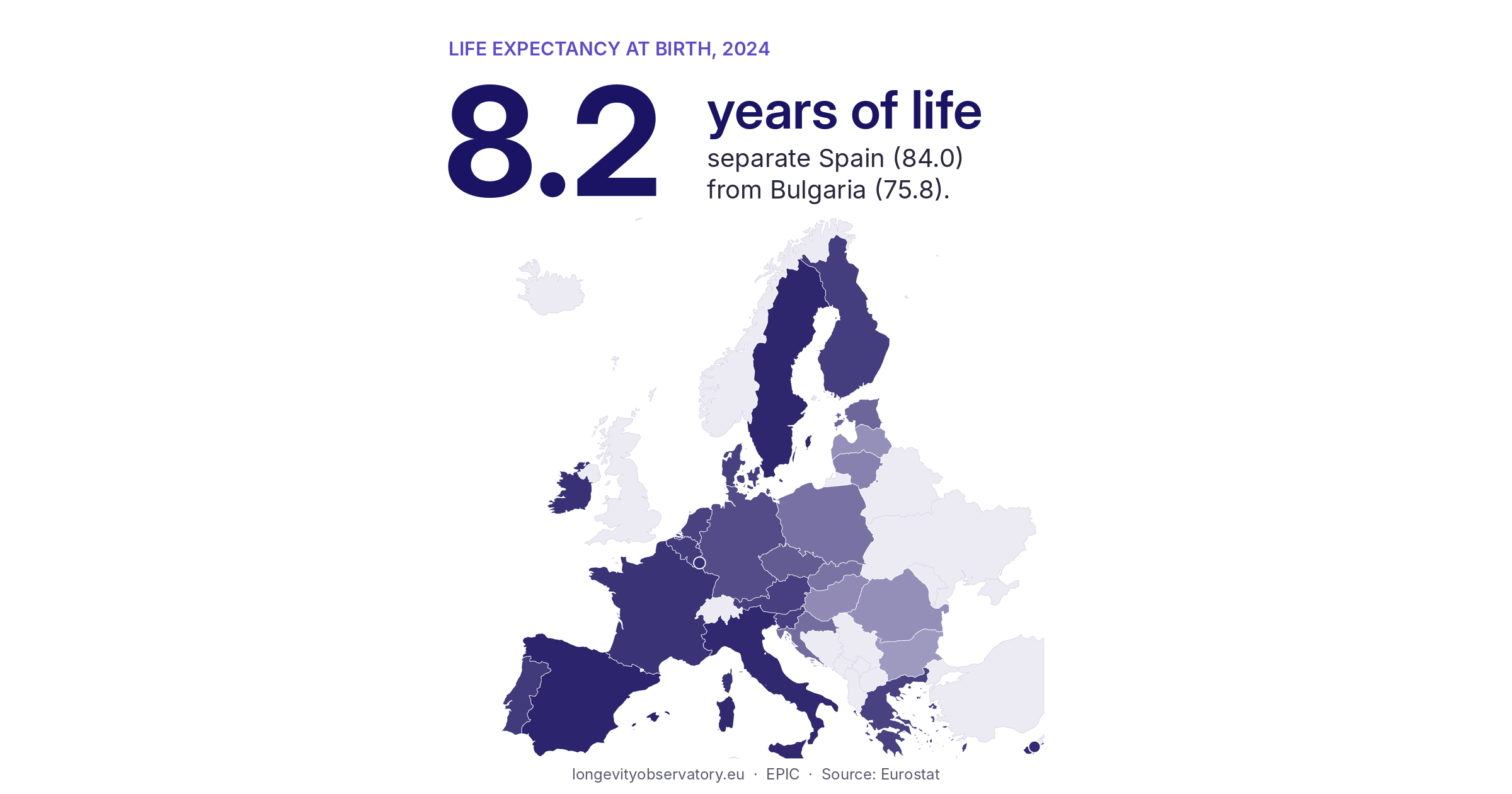
Life expectancy at birth runs from 75.8 years in Bulgaria to 84.0 in Spain. After 65, about half of the years Europeans have left are healthy ones.
The European Policy Innovation Council (EPIC) today launches the European Demographic and Longevity Observatory, a public site that tracks how Europe’s population is changing and whether longer lives are also healthier lives. It covers the EU and all 27 Member States with 15 headline measures drawn from Eurostat, and it is free to use at longevityobservatory.eu.
Eurostat’s latest figures give a child born in Spain in 2024 a life expectancy of 84.0 years. A child born in Bulgaria can expect 75.8. The EU average is 81.5.
That is 8.2 years of life between two Member States of the same Union.
The gap in healthy years is wider. At 65, a person in Sweden can expect 14.2 more years free of activity limitation. In Latvia the figure is 4.2. Across the EU, a 65-year-old can expect another 20.2 years of life, of which 10.3 are free of activity limitation.
What else the first release shows
- Preventable deaths. Preventable mortality below age 75 stands at 309.0 per 100,000 people in Latvia and 89.7 in Cyprus (2023), a difference of more than three to one.
- Access to care. In Greece, 27.8% of people aged 65 and over report an unmet medical need because of cost, distance or waiting lists. The EU figure is 3.3% (2025).
- More deaths than births. Deaths exceeded births in the EU by about 1.35 million in 2025 (provisional). The population still grew, because net migration outweighed natural change.
- The oldest group is growing fastest. Under Eurostat’s EUROPOP2025 baseline, the share of the EU population aged 80 and over rises from 6.2% in 2025 to 10.9% in 2050.
Longevity as public policy
Longevity is mostly discussed as a market: clinics, diagnostics and supplements for people who can pay. The Observatory treats it as a question of public policy. It asks how long Europeans live, how many of those years are healthy, and how far apart Member States stand on both.
“Longevity today is a hobby for the rich. These numbers show that for most Europeans it depends on where they were born,” said Krzysztof Bulski, Director, Strategy for Europe Programme at EPIC. “The question for health policy is what it takes for every clinic in Europe, starting with the paediatrician’s office, to work as a longevity clinic.”
“The distance between Member States is a measure of inequality inside the Union. It is also a measure of how much room Europe has to converge. Europeans as a whole can live longer and healthier lives, and the Observatory sets the baseline for checking whether they do,” Bulski added.
What the Observatory offers
The site shows one measure at a time and does not rank or score countries. Every chart can be downloaded, linked or embedded, and the full dataset and the Methods Note are open for download.
- A map of Europe with a year slider, and a page for each of the 27 Member States.
- A comparison of any two countries against the EU.
- A policy tracker following four EU dossiers.
- A data explorer with all 21,460 observations and CSV export.
The Observatory was introduced at the Warsaw Longevity Forum on 25 November 2026. Its partners are Longevity for Everyone (Długowieczność dla Każdego) and the Polish Society of Longevity Medicine.
Three further releases are planned for 2027: commentary and an external review of the Methods Note in the first quarter, a tracker of live EU legislative files in the second, and medicines and innovation as a third pillar in the third.
Notes to editors
- Data. All figures come from Eurostat, extracted on 5 November 2026. Reference years are given with each figure. The 2025 figures for births and deaths are provisional.
- Healthy life years. The measure counts years expected to be lived free of activity limitation. It combines mortality data with a survey question, so it should be read together with life expectancy. The Methods Note sets out its limits.
- Site. longevityobservatory.eu
About EPIC
The European Policy Innovation Council (EPIC) is a Brussels-based policy platform that measures whether Europe delivers on its own commitments. Its Draghi Observatory (draghiwatch.eu) tracks implementation of the 383 recommendations of the Draghi report. Its Enlargement Observatory (readinessindex.eu) scores the readiness of EU candidate countries.
Contact
Krzysztof Bulski, Director, Strategy for Europe Programme, EPIC: kbulski@thinkepic.eu
European Policy Innovation Council ASBL, Silversquare, Square de Meeûs 35, 1000 Brussels